
3D Holograms Future: Revolutionizing Technology
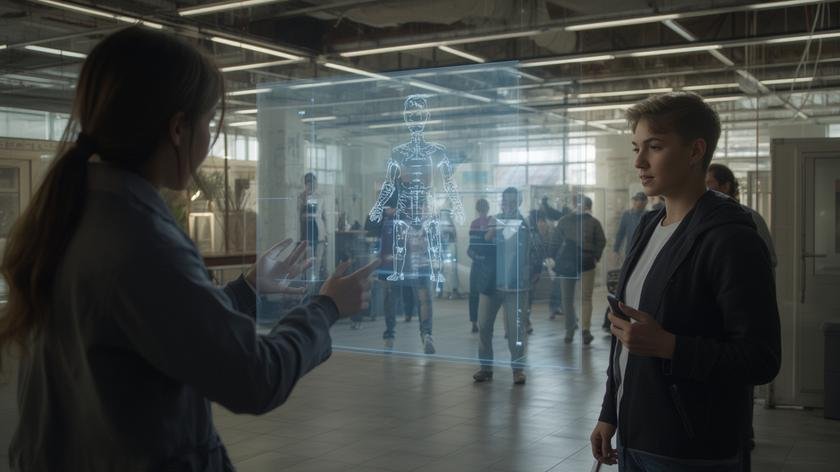
The rapid evolution of visual technologies has moved beyond flat screens and traditional projections, ushering in an era where light can be sculpted into tangible forms that appear to float in mid‑air. Researchers and engineers are now converging on a vision that could redefine how information is presented, experienced, and interacted with, positioning 3D holograms future at the forefront of next‑generation displays.
Thank you for reading this post, don't forget to subscribe!While conventional augmented reality overlays digital content onto the physical world, emerging holographic platforms aim to recreate entire objects with depth cues that the human eye interprets as real. This shift promises to bridge the gap between virtual constructs and the tangible environment, creating immersive experiences that feel both authentic and responsive, a development that could profoundly influence sectors ranging from education to entertainment and beyond.
## Table of Contents
– Understanding the Technology
– Current Applications
– Emerging Trends and Future Scenarios
– Challenges and Ethical Considerations
– Comparison of Holographic Solutions
– Frequently Asked Questions
– Conclusion and Final Takeaways
## Understanding the Technology
Holography relies on the interference pattern of coherent light sources, typically lasers, to encode the amplitude and phase information of a scene. Modern implementations use spatial light modulators (SLMs) to dynamically alter these patterns, enabling real‑time generation of three‑dimensional visuals. The process begins with a digital model that is sliced into numerous depth layers; each layer is then projected onto a photoreceptive surface, where constructive and destructive interference reconstructs the light field.
Advancements in materials science have introduced metasurfaces—ultra‑thin, nanostructured layers that manipulate light with unprecedented precision. Coupled with high‑speed computing, metasurfaces can produce holograms that adapt instantly to viewer movement, mitigating common artifacts like ghosting or limited viewing angles. When these sophisticated displays are paired with sensor arrays that track eye position and gestures, they lay the groundwork for truly interactive holographic ecosystems.
## Current Applications
### Medical Training and Planning
Surgical simulations now employ holographic anatomy models that allow physicians to explore patient‑specific structures without invasive procedures. By projecting layered organ systems in true scale, surgeons can rehearse complex interventions, reducing operative time and improving outcomes.
### Design and Prototyping
Industrial designers leverage holographic prototypes to assess ergonomics and aesthetics before committing to costly physical molds. The ability to rotate, scale, and modify designs in mid‑air accelerates the iterative process and fosters collaborative creativity across dispersed teams.
### Entertainment and Live Events
Concerts and theater productions increasingly incorporate floating stage elements, creating visual spectacles that blend performers with dynamic, three‑dimensional set pieces. Audiences experience a depth that screens cannot replicate, enhancing immersion and emotional impact.
Explore more about how holographic tech reshapes collaborative workflows.
## Emerging Trends and Future Scenarios
One of the most compelling trajectories is the convergence of holography with Virtual Reality. While VR immerses users within a fully synthetic environment via head‑mounted displays, the hybrid approach envisions rooms where holographic projections interact seamlessly with VR headsets, delivering tactile feedback through haptic surfaces aligned with floating images. This synergy could unlock training environments where learners manipulate virtual objects that physically respond to touch.
Another trend is the democratization of holographic creation tools. Open‑source software stacks now enable independent creators to generate high‑fidelity holograms using commodity hardware, reducing barriers to entry and fostering a vibrant ecosystem of content. Additionally, cloud‑based rendering services promise to offload computationally intensive tasks, allowing thin‑client display units to present complex holograms without local processing power.
Looking ahead, the integration of artificial intelligence will automate scene generation, optimizing light field calculations in real time based on contextual cues. AI‑driven compression algorithms could also make streaming holographic content viable over standard broadband, opening doors to remote holographic meetings that feel as personal as face‑to‑face encounters.
Read our deep dive into holographic displays powered by AI.
## Challenges and Ethical Considerations
### Technical Limitations
Current holographic systems contend with high power consumption, limited resolution, and narrow viewing zones. Scaling up to room‑size installations demands breakthroughs in energy‑efficient lasers and affordable SLMs. Moreover, achieving true color fidelity across the entire visible spectrum remains an open research problem.
### Data Privacy and Security
When holographic interfaces capture biometric data—such as gaze direction, hand gestures, and spatial positioning—they generate sensitive personal information. Robust encryption and transparent consent mechanisms are essential to prevent misuse or unauthorized profiling.
### Societal Impact
The immersive nature of holographic media raises concerns around manipulation, misinformation, and desensitization. As visual fidelity improves, distinguishing between authentic and fabricated content could become increasingly difficult, necessitating reliable verification standards and media literacy initiatives.
## Comparison of Holographic Solutions
| Attribute | Laser‑Based SLM | Metasurface Projection | Volumetric Light Field | 3D holograms future Impact |
|---|---|---|---|---|
| Resolution (px per degree) | 720 | 1200 | 500 | High resolution enhances realism |
| Power Consumption | High | Medium | Low | Efficiency drives wider adoption |
| Viewing Angle | 30° | 45° | 360° | Broader angles improve accessibility |
| Scalability | Limited | Moderate | High | Scalable solutions enable public venues |
## Frequently Asked Questions
**What distinguishes holograms from traditional 3‑D graphics?**
Holograms reconstruct light fields, offering view‑dependent depth without glasses.
**Can holographic displays work outdoors?**
Yes, with high‑luminosity lasers and weather‑resistant components.
**How does Virtual Reality complement holography?**
VR provides immersive context, while holograms add physical‑space interaction.
**Are there health risks associated with prolonged exposure?**
Current standards indicate no adverse effects when exposure limits are met.
**What industries will adopt holography first?**
Healthcare, design, and entertainment are leading early adopters.
## Conclusion and Final Takeaways
The trajectory of visual communication is unmistakably shifting toward three‑dimensional, interactive light constructs. As hardware matures and software ecosystems coalesce, the 3D holograms future promises to dissolve the barrier between digital imagination and physical reality. Stakeholders who invest in research, ethical frameworks, and cross‑disciplinary collaboration will shape a landscape where holography becomes a ubiquitous medium for education, commerce, and culture.
For readers seeking deeper insight, a quick web search can surface the latest breakthroughs and case studies: Search results for 3D Holograms Future: Revolutionizing Technology.
Continuing to monitor standards, performance metrics, and societal impacts will ensure that this transformative technology delivers lasting value while respecting user trust and safety.