Andromeda Galaxy Facts: Unveiling the Mysteries of Our Nearest Neighbor
When night sky enthusiasts glance upward, the faint smudge that glows faintly in the autumnal sky holds an entire universe of intrigue. Among the countless mysteries waiting to be explored, the Andromeda galaxy facts illuminate not only the mechanics of a neighboring spiral but also provide a mirror for our own galactic home.
Thank you for reading this post, don't forget to subscribe!By dissecting these details, astronomers gain a clearer picture of cosmic evolution, gravitational dance, and the eventual destiny of massive star systems. The following sections delve deep into the measurements, structures, and dynamic processes that make this celestial neighbor a cornerstone of modern astrophysics.
Table of Contents
- Overview of the Andromeda Galaxy
- Distance, Size, and Mass
- Star Formation and Stellar Populations
- Black Hole and Core Dynamics
- Satellite Galaxies and Future Collision
- Observing Andromeda from Earth
- Andromeda vs Milky Way Comparison
- FAQ
- Conclusion and Final Takeaways
Overview of the Andromeda Galaxy
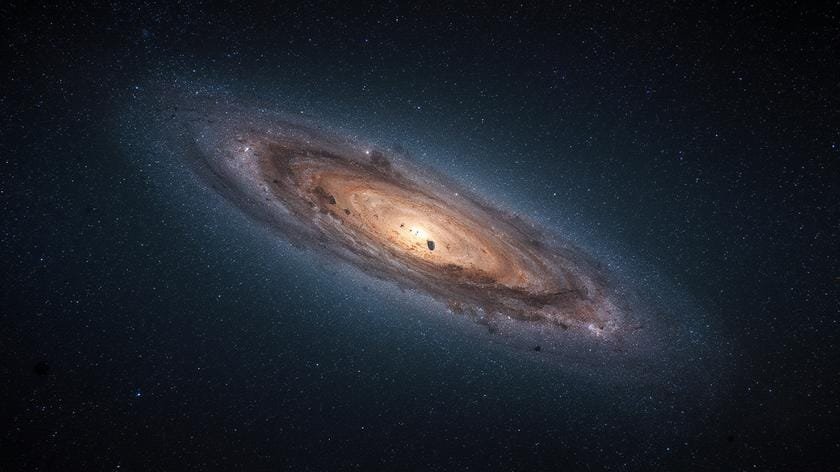
Designated as M31, the Andromeda Galaxy is the largest member of the Local Group, a collection of more than 50 galaxies bound by mutual gravitation. Its classic spiral arms and bright central bulge have been recorded since antiquity, yet only in the past century have astronomers quantified its true scale.
Modern observations place Andromeda roughly 2.54 million light‑years from the solar system, making it the most distant object visible to the unaided eye under dark skies. Its prominence owes to a dense concentration of young, blue stars along its arms, contrasted by a reddish halo of aged stellar populations.
Distance, Size, and Mass
Precision distance measurements stem from a combination of Cepheid variable calibration and geometric techniques such as the tip of the red‑giant branch (TRGB). The consensus distance, 778 kiloparsecs, translates to a scale where 1 arcsecond subtends roughly 3.8 parsecs within the galaxy.
Spanning approximately 220 kpc in diameter, Andromeda dwarfs the Milky Way by about 30 percent in linear dimensions. Its total mass, inferred from rotation curves and satellite dynamics, lies in the range of 1–1.5 × 10¹² M☉, indicating a dark‑matter halo that dominates the gravitational profile.
Star Formation and Stellar Populations
Star‑forming regions are most vigorous within the galaxy’s spiral arms, where densities of molecular clouds reach the threshold for gravitational collapse. Infrared surveys reveal that Andromeda’s current star‑formation rate is modest—about 0.4 M☉ yr⁻¹—substantially lower than that of many comparable spirals.
Nevertheless, the galaxy hosts a rich tapestry of stellar ages. The central bulge is dominated by metal‑rich, population‑II giants, while the outskirts contain a mixture of older halo stars and younger, metal‑poor clusters that trace accretion events over billions of years.
Black Hole and Core Dynamics
At the heart of Andromeda lies a supermassive black hole, designated M31*.Recent spectroscopic measurements estimate its mass at roughly 1.4 × 10⁸ M☉—about an order of magnitude larger than the Milky Way’s Sagittarius A*. This massive nucleus influences the inner kiloparsec, stirring a complex pattern of stellar orbits and fueling occasional low‑level activity detectable in X‑ray wavelengths.
The velocity dispersion of bulge stars peaks at ~250 km s⁻¹, a testament to the deep gravitational well carved by the black hole and surrounding dense star cluster. Such dynamics are pivotal for calibrating the M‑σ relation that links black‑hole mass to host‑galaxy properties.
Satellite Galaxies and Future Collision
Andromeda is accompanied by a retinue of dwarf companions, the most notable being M32, M110, and a plethora of ultra‑faint spheroidals. Their orbital paths bear the signatures of past tidal interactions, evidenced by stellar streams that wrap around the primary disk.
Numerical simulations, anchored by current proper‑motion measurements from the Hubble Space Telescope and Gaia, predict a head‑on encounter with the Milky Way in roughly 4.5 billion years. The merger will give rise to a new elliptical galaxy, sometimes colloquially dubbed “Milkomeda.”
Observing Andromeda from Earth
Amateur astronomers can locate Andromeda by tracing a line from the Great Square of Pegasus through the star Alpheratz in Andromeda’s western wing. With a modest 6‑inch telescope, the galaxy’s core splits into a bright, oval nucleus surrounded by a diffuse halo.
Photographic enthusiasts often employ broadband filters (e.g., Luminance, RGB) to capture the faint outer arms, while narrowband imaging can isolate emission from H II regions, revealing pockets of active star formation. Dark‑sky sites enhance visibility, allowing the faint stellar halo to be discerned even without optical aid.

Andromeda vs Milky Way Comparison
| Property | Andromeda | Milky Way |
|---|---|---|
| Distance from Earth | 2.54 million ly | 0 ly (our location) |
| Diameter | ≈220 kpc | ≈200 kpc |
| Stellar Mass | ≈1 × 10¹¹ M☉ | ≈5 × 10¹⁰ M☉ |
| Central Black‑Hole Mass | ≈1.4 × 10⁸ M☉ | ≈4 × 10⁶ M☉ |
| Star‑Formation Rate | 0.4 M☉ yr⁻¹ | 1.7 M☉ yr⁻¹ |
| Number of Known Satellites | ≈30 | ≈50 |
FAQ
What is the approximate distance to Andromeda?
About 2.5 million light‑years.
How many stars does Andromeda contain?
Roughly one trillion stars.
Will Andromeda collide with our galaxy?
Yes, in about 4.5 billion years.
Can the naked eye see Andromeda?
Under dark skies, its core is visible.
What is the mass of Andromeda’s central black hole?
Approximately 140 million solar masses.
Conclusion and Final Takeaways
The exploration of Andromeda galaxy facts underscores the interconnectedness of cosmic structures. From its expansive spiral arms to the imposing central black hole, each attribute offers a window into the processes that shape large‑scale galaxies.
As observational technology advances and simulation fidelity improves, our comprehension of this neighboring giant will sharpen, providing vital context for the future of the Local Group and the ultimate fate of the Milky Way. Continued study promises not only academic enrichment but also a deeper appreciation of our place within a dynamic universe.
For those eager to expand their knowledge, a quick web search can surface the latest research papers and news releases: search results. This sustained curiosity fuels the scientific endeavor that keeps the cosmos within reach.