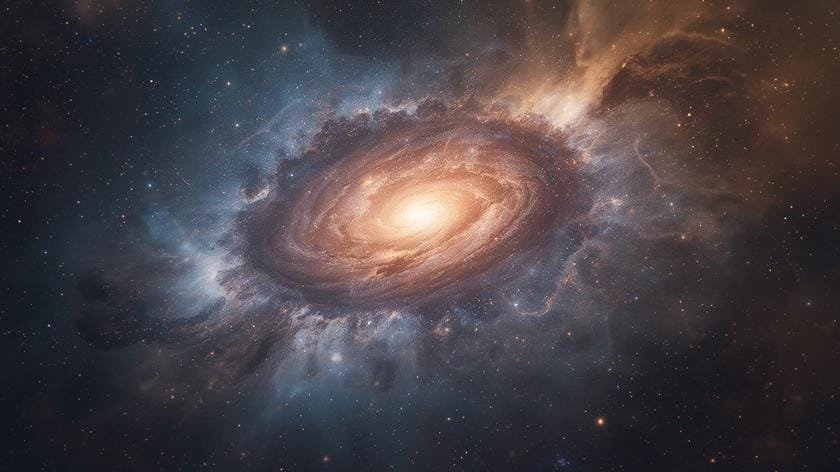
AI Cosmology Simulations Revolutionize Space Exploration
The quest to map the universe’s vast tapestry has entered a transformative era, where computational power meets astrophysical insight. Researchers are now able to generate virtual universes that evolve under the same physical laws governing the real cosmos, unlocking scenarios that would otherwise remain forever out of reach. By embedding sophisticated algorithms into massive simulations, scientists can explore the formation of galaxies, the behavior of dark matter, and the subtle imprint of cosmic inflation with unprecedented fidelity.
Thank you for reading this post, don't forget to subscribe!A pivotal catalyst in this shift is the emergence of AI AI cosmology simulations. These hybrid systems blend traditional numerical methods with adaptive learning models, allowing simulations to self‑optimize as they progress. The result is a dynamic framework that not only reproduces known structures but also predicts novel phenomena, offering a powerful lens through which we can interrogate the universe’s deepest mysteries.
## Table of Contents
– Understanding AI Cosmology Simulations
– Key Technologies Driving the Simulations
– Methodology and Data Integration
– Scientific Breakthroughs Enabled
– Challenges and Ethical Considerations
– Future Outlook
– Comparison Table
– FAQ
– Conclusion and Final Takeaways
### Understanding AI Cosmology Simulations {#understanding-ai-cosmology-simulations}
The term AI-driven universe modeling describes a class of computational experiments where neural networks act as surrogate solvers for complex differential equations. Rather than solving every particle interaction from first principles, the system learns an approximate mapping from a limited set of high‑resolution calculations. This approach reduces computational overhead while preserving critical physical accuracy.
Early implementations relied on modest feed‑forward networks, but modern architectures now employ transformer‑based models that can capture long‑range correlations across billions of simulated particles. The refinement cycle—training on simulation snapshots, validating against observational data, and iterating—mirrors the scientific method, ensuring that each generation of the model is more faithful to reality.
### Key Technologies Driving the Simulations {#key-technologies-driving-the-simulations}
Several breakthroughs have converged to make AI AI cosmology simulations viable at scale:
1. **High‑Performance Computing (HPC) Clusters** – Exascale supercomputers provide the raw arithmetic capacity needed for both traditional N‑body calculations and the massive matrix multiplications inherent to deep learning.
2. **Graph Neural Networks (GNNs)** – By representing matter distribution as a graph, GNNs excel at encoding spatial relationships, enabling accurate prediction of gravitational dynamics.
3. **Differentiable Physics Engines** – These engines expose physical parameters to gradient‑based optimization, allowing the learning algorithm to fine‑tune constants such as the Hubble parameter directly from data.
4. **Hybrid Cloud‑Edge Workflows** – Distributed storage of simulation outputs across cloud platforms ensures seamless access for collaborative analysis, while edge devices perform quick inference for real‑time visualization.
Each component contributes to a pipeline that can generate a full‑scale cosmological volume in days rather than months, dramatically accelerating hypothesis testing.

### Methodology and Data Integration {#methodology-and-data-integration}
The workflow can be distilled into four stages:
| Stage | Description | Typical Tools |
|——-|————-|—————|
| **Initial Conditions** | Generate primordial density fields using inflationary models. | CAMB, CLASS |
| **Coarse Simulation** | Run a low‑resolution N‑body run to capture large‑scale structure. | GADGET‑4, PKDGRAV |
| **Machine‑Learning Upscaling** | Train a GNN on high‑resolution patches; apply to coarse output to infer fine details. | PyTorch Geometric, TensorFlow |
| **Validation & Calibration** | Compare synthetic sky maps with surveys (e.g., Euclid, LSST). | Astropy, TOPCAT |
Crucially, the upscaling step is where the Artificial Intelligence Cosmology component shines. By learning the statistical mapping from low‑ to high‑resolution regimes, the model can synthesize realistic galaxy morphologies, star formation histories, and even mock gravitational‑wave event catalogs.
### Scientific Breakthroughs Enabled {#scientific-breakthroughs-enabled}
The synergy of AI and cosmology has already yielded concrete insights:
– **Dark Matter Substructure** – Simulations reveal a richer spectrum of sub‑halo populations, informing indirect detection strategies.
– **Reionization Epoch Mapping** – By integrating radiative‑transfer modules with learned emissivity functions, researchers have produced high‑fidelity timelines for the universe’s first light.
– **Neutrino Mass Constraints** – Fine‑grained velocity fields generated by the AI layer improve the sensitivity of large‑scale surveys to subtle neutrino signatures.
– **Cosmic Web Topology** – Advanced pattern‑recognition algorithms classify filamentary structures, enabling statistical tests of modified gravity theories.
These outcomes underscore how AI AI cosmology simulations are not merely computational curiosities but essential instruments for next‑generation cosmology.
### Challenges and Ethical Considerations {#challenges-and-ethical-considerations}
Despite their promise, several hurdles remain:
1. **Interpretability** – Deep models act as black boxes; extracting physically meaningful parameters demands novel explainability techniques.
2. **Bias Propagation** – Training data derived from existing surveys can embed observational biases, potentially skewing simulated predictions.
3. **Resource Equity** – Exascale access is limited to well‑funded institutions, raising concerns about research inclusivity.
4. **Data Privacy** – While cosmological data is public, ancillary datasets (e.g., private telescope logs) must be handled with proper licensing.
Addressing these issues requires community‑wide standards, open‑source frameworks, and robust peer review of AI‑enhanced results.
### Future Outlook {#future-outlook}
Looking ahead, the field anticipates several transformative trends:
– **Self‑Supervised Cosmology** – Models that learn directly from raw sky images without labeled inputs could bypass many calibration steps.
– **Quantum‑Accelerated Solvers** – Emerging quantum algorithms may further reduce the cost of solving Einstein’s field equations within simulation loops.
– **Cross‑Disciplinary Fusion** – Techniques from climate modeling, fluid dynamics, and bioinformatics are expected to cross‑pollinate, enriching simulation fidelity.
– **Public Interactive Simulators** – Web‑based platforms powered by lightweight AI inference will let educators and enthusiasts explore virtual universes in real time.
These developments suggest that the boundary between observation and simulation will continue to blur, ushering an era where theoretical predictions can be visualized and tested instantly.
## Comparison Table {#comparison-table}
| Feature | Traditional N‑Body Simulations | AI‑Enhanced Simulations |
|---|---|---|
| Computation Time (per Gpc³) | Weeks–Months | Days–Weeks |
| Spatial Resolution | Limited by particle count | Sub‑grid refinement via learned upscaling |
| Flexibility to New Physics | Requires code rewrite | Retrain model on modified data |
| Interpretability | High (direct physics equations) | Medium (requires explainability tools) |
| Resource Accessibility | GPU/CPU clusters | GPU‑accelerated inference; lower barrier after training |
## FAQ {#faq}

**Q1: How do AI models improve simulation speed?**
A: By learning surrogate representations, they replace costly numerical solvers for many steps.
**Q2: Can these simulations predict unknown physics?**
A: They can highlight anomalies, guiding targeted theoretical investigations.
**Q3: Are the results validated against real observations?**
A: Yes, synthetic sky maps are routinely compared with survey data such as LSST.
**Q4: What hardware is required for training?**
A: Modern GPUs or dedicated AI accelerators on an HPC cluster.
**Q5: Is the code open source?**
A: Several frameworks (e.g., CosmoFlow) are publicly available under permissive licenses.
**Q6: How does one mitigate bias in the training set?**
A: By incorporating diverse observational catalogs and applying debiasing algorithms.
## Conclusion and Final Takeaways {#conclusion}
The integration of artificial intelligence into cosmological modeling marks a decisive leap toward more agile, detailed, and insightful exploration of the universe. By leveraging AI AI cosmology simulations, scientists can now interrogate complex phenomena—such as dark matter micro‑structures and early‑universe reionization—with a speed and granularity previously unattainable. While challenges around interpretability, bias, and equitable access persist, the collaborative momentum across astrophysics, computer science, and high‑performance computing promises continual refinement of these tools.
As the community embraces self‑supervised learning, quantum‑accelerated solvers, and open‑source ecosystems, the line between observation and simulation will further dissolve, empowering a generation of researchers to test bold hypotheses in near‑real time. For those eager to stay at the frontier, engaging with the emerging AI‑centric workflows today will be essential to shaping the next chapter of space exploration.
—
For additional context, you may explore recent discussions on this topic through a quick web search: Google Search.